
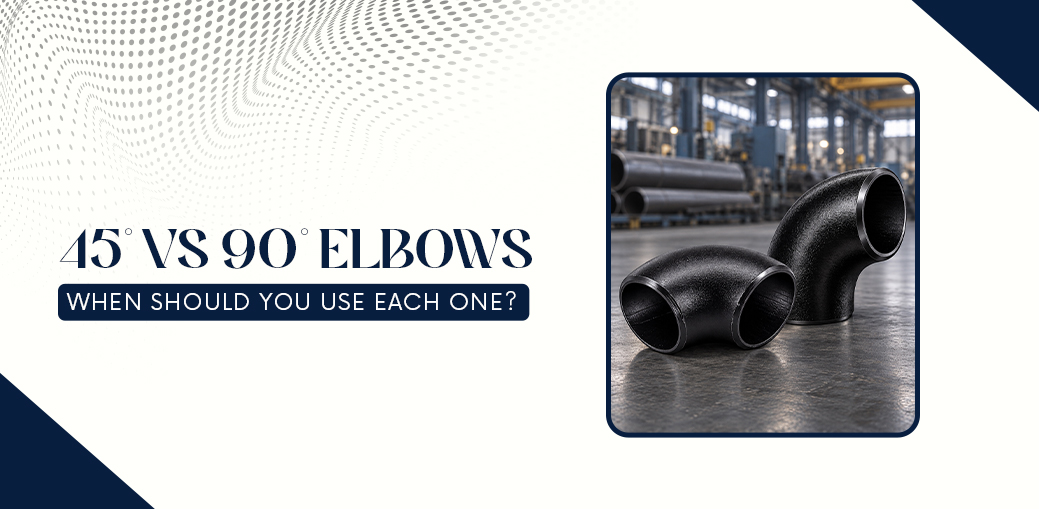
Piping systems rarely run in a completely straight line. Changes in direction are often necessary to connect equipment, navigate around structures, or create an efficient piping layout. Elbows are among the most commonly used fittings for making these directional changes.
Two common options are 45° and 90° elbows. Although both are designed to change the direction of a pipeline, they create different flow paths and are suited to different installation requirements. Choosing between them depends on the layout, available space, flow requirements, and overall system design.
Understanding 45° and 90° Elbows
A 45° elbow changes the direction of the pipe by 45 degrees. It provides a more gradual change in direction and can be useful when a piping system needs to shift direction without making a sharp turn.
A 90° elbow, on the other hand, changes the direction by 90 degrees. It is commonly used when a pipe needs to make a complete right-angle turn, such as changing from a horizontal run to a vertical one.
Both types are available in different sizes, materials, pressure ratings, and connection configurations. The correct selection should always match the requirements of the piping system.
When to Use a 45° Elbow
A 45° elbow can be useful when the piping layout allows for a more gradual directional change. Because the change in direction is less abrupt, 45° elbows can be preferred in applications where maintaining smoother flow is an important consideration. They can also be useful when the layout requires a diagonal transition rather than a direct right-angle turn.
For example, two 45° elbows can sometimes be used together to create a 90° directional change while providing a different flow path than a single 90° elbow. However, this approach also introduces an additional fitting and connection, so the complete system design must be considered.
When to Use a 90° Elbow
A 90° elbow is the straightforward choice when a pipeline needs to make a right-angle turn. They are widely used in piping layouts where horizontal and vertical sections need to be connected or where the system needs to turn around an obstruction or equipment connection.
A 90° elbow can also provide a compact directional change compared with designing a longer angled transition. This makes it particularly useful where the piping layout requires a clear right-angle connection.
However, the sharper change in direction can have a greater effect on flow behaviour and pressure loss compared with a more gradual directional change. For systems where flow efficiency is particularly important, engineers should consider the elbow geometry and overall piping design.
How to Choose Between 45° and 90° Elbows
The correct elbow should be selected according to the application’s actual requirements.
Consider a 45° elbow when:
- A gradual directional change is preferred.
- The piping layout has enough space for the transition.
- Flow characteristics are an important design consideration.
- A diagonal pipe route is required.
Consider a 90° elbow when:
- A right-angle turn is required.
- Horizontal and vertical pipe sections need to connect.
- The available layout calls for a compact directional change.
- Equipment or structural arrangements require a 90° route.
Other factors such as pipe size, material compatibility, pressure rating, temperature, connection type, and applicable standards should also be checked before selecting the fitting.
Conclusion
The choice between a 45° and 90° elbow ultimately depends on the piping layout and operating requirements. A 45° elbow provides a more gradual directional change, while a 90° elbow is ideal for direct right-angle turns. Selecting the appropriate fitting helps create a piping system that is practical, reliable, and suited to its intended service.
For industrial valves, fittings, and piping solutions, visit https://akarimjee.com.
For inquiries, pricing, and bulk orders, contact us: 021-32422431