
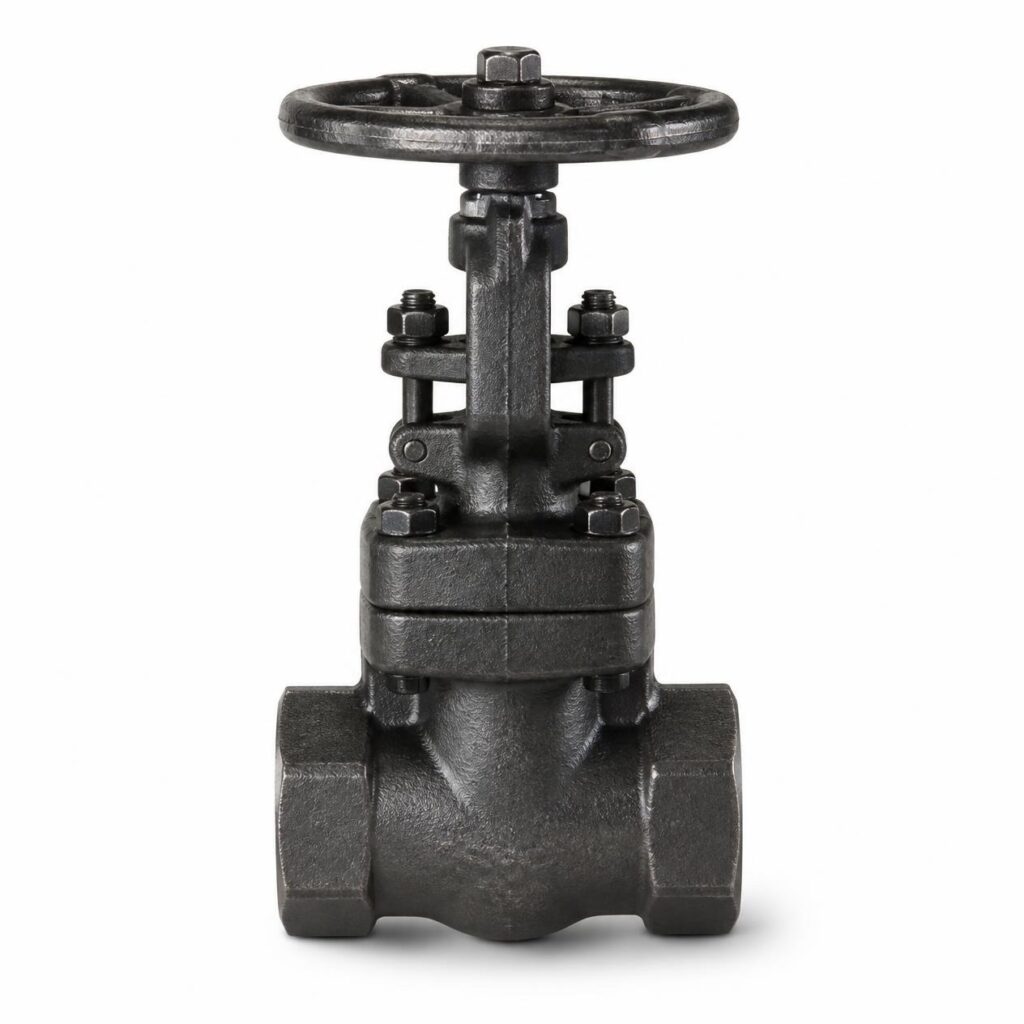
Forged Steel Gate Valves
Forged steel gate valves are compact, high-pressure isolation valves for small-bore piping. Their forged bodies are dense and strong, so they handle high pressures and temperatures in a small size.
We supply API 602 forged gate valves in carbon, low-temperature and alloy steel, with socket weld, threaded or butt weld ends, for oil & gas, refinery, steam and power piping.
Specifications
| Product name | Forged Steel Gate Valve |
|---|---|
| Valve type / design | Solid wedge, bolted or welded bonnet, OS&Y rising stem, reduced or full port |
| Body material | ASTM A105 / A105N; A350 LF2 (low temp); A182 F11 / F22 (alloy); A182 F304 / F316; 13Cr or stellite trim |
| Size range | ½" to 2" (DN15 – DN50) |
| Pressure rating | Class 800 / 1500; Class 2500 on request |
| End connections | Socket weld (ASME B16.11), threaded NPT (ASME B1.20.1), butt weld |
| Standards | API 602, ASME B16.34, API 598 testing |
| Applications | Oil & gas, refinery, steam, power and instrument lines |
Industrial uses
- Oil & gasSmall-bore process, drain and vent isolation.
- Refineries & petrochemicalHigh-pressure hydrocarbon branch lines.
- Steam & powerIsolation on high-temperature steam drains and instrument lines.
- Instrument take-offsRoot valves for pressure gauges and transmitters.
- UtilitiesCompressed air, nitrogen and cooling water small-bore lines.
Frequently asked questions
What does Class 800 mean?
Class 800 is an intermediate pressure class used for forged valves under API 602, rated between ASME Class 600 and 900 at the same temperature. It is the standard rating for small-bore socket weld and threaded valves.
Why forged instead of cast?
Forging produces a dense, uniform grain structure with no casting porosity. That makes forged valves stronger and more reliable at high pressure in small sizes.
Bolted bonnet or welded bonnet?
A bolted bonnet can be opened for maintenance. A welded bonnet removes the bonnet gasket as a leak path and is chosen for high pressure, high temperature or hazardous service.